
Brand · Microencapsulated PCM
Micronal
Formaldehyde-free microencapsulated PCM with comfort-range melt points for building materials, mattresses, textiles, and more.
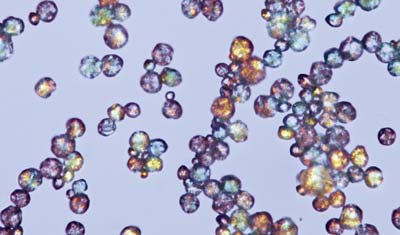
Originally pioneered by BASF and now manufactured within the Alexium portfolio, Micronal is one of the most widely studied microencapsulated phase change materials in the world — available as an aqueous liquid dispersion or as redispersible powders.
21–28°C
Melt points
2–20 µm
Capsule size
Dispersion / Powder
Forms
An iconic PCM, now part of Alexium.
- Developed for the construction industry to bring thermal mass back into modern lightweight buildings, Micronal has been deployed in gypsum wallboards, plasters, and radiant ceiling systems across Europe — and in landmark reference projects from the Solar Decathlon house in Washington D.C. to commercial buildings, schools, and contemporary residences.
- It is offered as both an aqueous liquid dispersion (Micronal 24S and 28S) and as redispersible powders, covering building materials, bedding, textiles, and other diverse use cases.
- Micronal strengthens the combined portfolio with comfort-range melt points that complement our Nextek™, Vivtek™, and EcoTek grades.
How Micronal works.
- Each microcapsule is a polymer sphere, 2–20 microns in diameter, containing a paraffin-wax core. As the surrounding temperature rises through the wax's melt point, the core absorbs heat as latent energy and the temperature of the system stays nearly constant. As the room cools, the wax solidifies and releases the stored heat back.
- The result is a passive, mechanically robust thermal buffer: 1.5 cm of Micronal PCM gypsum wallboard has thermal storage capacity comparable to roughly 9 cm of concrete or 12 cm of brick — intelligent temperature management in an extremely lightweight form factor.
Why Micronal matters across industries.
- Comfort-range melt points at 21°C, 23°C, 24°C, 26°C, and 28°C — temperatures other PCM grades don't reach as precisely, ideal for indoor air, sleep surfaces, and wearable comfort.
- Formaldehyde-free microencapsulation engineered for long-term indoor use.
- High cycle stability — tested through 10,000 thermal cycles, equivalent to around 30 years of daily use, with no notable change in performance.
- High surface-to-volume ratio — 1 g of Micronal offers approximately 30 m² of heat-exchange surface for rapid, even response.
- Liquid dispersion or powder — drops directly into existing wet processes (plasters, paints, coatings, slurries, foams) or dry blends (mortars, gypsum, cementitious mixes).
Proven in building materials.
- Micronal PCM gypsum wallboard carried roughly 3 kg of microcapsules per square metre, giving a 15 mm board the heat-storage capacity of a 9 cm concrete wall or a 12 cm brick wall.
- Latent heat capacity was approximately 330 kJ/m² at the switching temperature, with specific heat around 1.20 kJ/kgK and thermal conductivity around 0.18 W/(m·K).
- Switching temperatures of 23°C and 26°C matched the board to office and residential comfort ranges, cutting daytime temperature peaks and using cool night air to discharge stored heat.
- Reference projects included the Haus der Gegenwart in Munich (2005), which used 600 m² of Micronal PCM wallboard — 1,800 kg of phase change material in a single lightweight house.
- Figures are from the original BASF Micronal PCM gypsum wallboard technical data (2005) and are provided for historical reference.
Data centers and critical facilities.
- Micronal turns ordinary wallboard, plaster, aerated concrete, ceiling cassettes and architectural coatings into latent thermal mass, without changing how those materials are installed.
- Support spaces — electrical, UPS, battery and telecom rooms, network operations centers and offices — use a 23–26°C switching point to flatten daily peaks and hold a tighter temperature band, so mechanical systems can be sized closer to average load than peak.
- Data hall walls and ceilings can be specified just above the cold-aisle setpoint (for example 26–28°C for a 24°C setpoint), so the material stays charged in normal operation and slows the temperature climb when cooling is interrupted.
- Prefabricated, modular and edge facilities have almost no thermal mass: a 15 mm mPCM board gives a factory-built module the heat-storage capacity of roughly 9 cm of concrete without the weight or freight.
- mPCM is a finite buffer — it stores heat rather than removing it, then recharges once cooling returns. It is designed to work alongside chilled-water storage and UPS-backed fans and pumps, not to replace them.
- Supplied as dispersions, powders, slurries, plates and cassettes, Micronal can also be built into active thermal storage at custom melt points. Talk to us about co-development for thermal energy storage.
Applications
- Gypsum wallboards & drywall systems
- Interior plasters & renders
- Radiant cooling & heating ceilings
- Data center support spaces, halls & modular builds
- Mattresses & pillow cores
- Bedding textiles & duvets
- Performance & comfort apparel
- Architectural coatings & paints
- Light-construction panels
- HVAC load-shifting elements
Micronal 24S — Liquid Dispersion
- Form
- Aqueous liquid dispersion
- Melt point
- ~24°C
- Color / pH
- White / 8 – 9
- Density (20°C)
- 0.95 g/cm³
- Viscosity (20°C)
- 300 – 800 mPa·s
Micronal 28S — Liquid Dispersion
- Form
- Aqueous liquid dispersion
- Melt point
- ~28°C
- Composition
- Microencapsulated paraffin in polymethyl methacrylate shell
- Hazard class
- Not classified (CLP)
Micronal powder grades
- Form
- Redispersible powder
- Comfort melt points
- 21°C, 23°C, 26°C
- Latent heat (gypsum board)
- ~330 kJ/m² at switching temperature
- Capsule size
- 2 – 20 µm
Let's collaborate
What's your challenge?
From bedding to ballistic gear, our chemists partner with you to solve thermal, flame, and humidity problems at the molecular level.